
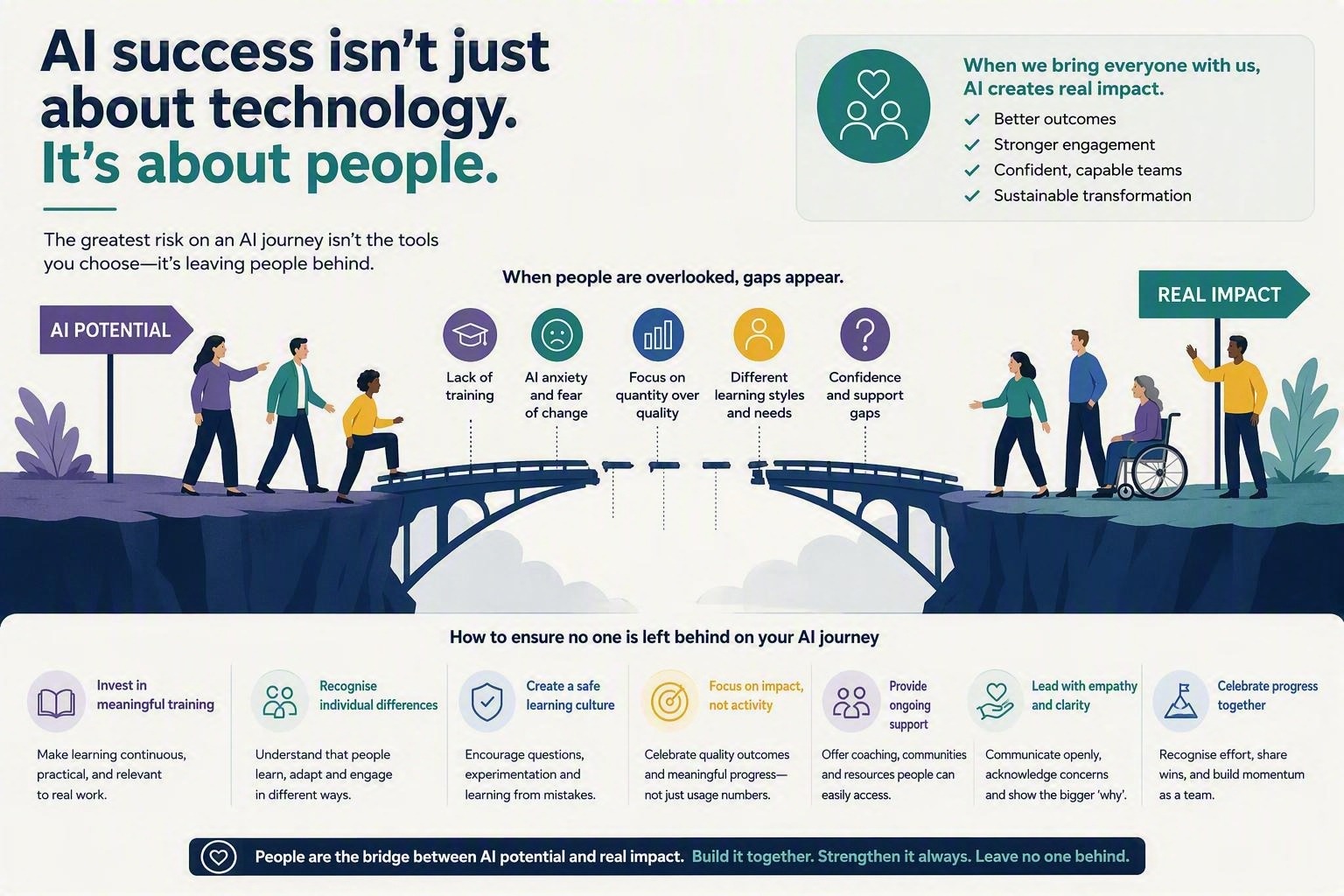
AI Transformation Isn't a Technology Challenge. It's a People Challenge.
There is an uncomfortable truth that many organisations are discovering as they accelerate their AI programmes:
The biggest risk to AI success isn't the technology itself. It's leaving people behind.
Boardrooms are investing millions in AI platforms, copilots, automation tools, and data initiatives. Productivity gains are promised. Efficiency metrics are tracked. Adoption dashboards are celebrated.
Yet beneath the surface, many employees are quietly struggling.
Some don't know where to start. Some don't understand how AI fits into their role. Some are worried about making mistakes. Others are concerned about what AI means for their future. And many simply haven't received the support they need to confidently embrace such a significant shift in how work gets done.
If organisations focus solely on AI utilisation metrics whilst neglecting the human experience, they risk creating a workforce that is disengaged, divided, and ultimately less productive.
The Danger of Measuring Activity Instead of Value
One of the most common mistakes organisations make is becoming obsessed with AI usage statistics.
How many prompts were entered?
How many documents were generated?
How many employees used the tool this week?
Whilst these metrics can indicate adoption, they rarely tell the full story.
The real question should be:
Are people producing better outcomes?
An employee generating twenty AI-created documents isn't necessarily adding more value than someone using AI thoughtfully to improve a single high-impact piece of work.
When leaders celebrate volume above all else, they unintentionally create behaviours that prioritise quantity over quality. Employees can feel pressured to use AI simply to demonstrate engagement, rather than to solve meaningful problems or improve customer outcomes.
Successful AI adoption should focus on impact, confidence, and effectiveness, not merely activity.
Not Everyone Starts from the Same Place
Another dangerous assumption is believing that everyone will adapt to technological change at the same pace.
They won't.
Every organisation contains individuals with different levels of digital confidence, learning styles, and personal attitudes towards change.
Some employees are naturally curious and eager to experiment. They'll become AI champions almost immediately.
Others may need more time. They may prefer structured learning, additional reassurance, or practical demonstrations before they feel comfortable incorporating AI into their workflow.
And that's perfectly normal.
Unfortunately, organisations often design AI rollouts around their early adopters. Training is delivered once. Resources are published. Champions are identified. Then leaders assume everyone else will catch up.
Many don't.
Instead, a silent gap begins to emerge between the confident users and those who are struggling in the background.
Over time, that gap can become a significant cultural and operational problem.
AI Anxiety Is Real
Whilst conversations about AI often focus on capability, organisations should not underestimate the emotional impact of rapid technological change.
Employees may worry about:
- Job security
- Skill relevance
- Performance comparisons
- Making mistakes with AI-generated outputs
- Looking incompetent in front of colleagues
- Falling behind peers who appear to be adapting faster
These concerns are rarely voiced openly.
People often hide uncertainty because they don't want to be perceived as resistant, incapable, or unwilling to learn.
As a result, leaders may believe adoption is progressing smoothly when, in reality, many employees are simply masking their concerns.
The best AI programmes create safe environments where questions are encouraged, learning is expected, and experimentation is viewed as part of the journey.
Training Isn't a One-Off Event
Far too many AI initiatives treat training as a tick-box exercise.
Employees attend a workshop. They receive access to a tool. A few guidance documents are shared.
Then they're expected to transform the way they work.
Imagine introducing a completely new business process and providing only a single training session. No follow-up support. No coaching. No opportunities to practise.
It would never be considered sufficient.
Yet this happens regularly with AI.
Good AI adoption requires a continuous learning culture that includes:
- Structured onboarding
- Practical use cases
- Role-specific guidance
- Peer learning communities
- Regular refresher sessions
- Ongoing support and coaching
- Clear governance and best practice
People need opportunities to build confidence over time, not just information on day one.
Inclusion Must Be Part of the AI Strategy
When we talk about inclusion, we often focus on demographics. However, AI introduces another dimension that organisations need to consider: digital inclusion.
Not everyone experiences technology in the same way.
Some individuals may have neurodivergent traits that affect how they approach learning new systems. Others may have accessibility requirements, confidence barriers, language challenges, or simply different ways of processing information.
A truly inclusive AI strategy recognises that people need different forms of support.
There is no one-size-fits-all approach.
The goal should not be to make everyone learn in exactly the same way. The goal should be to ensure everyone has an equal opportunity to succeed.
Leaders Set the Tone
Perhaps the most important factor in successful AI adoption is leadership behaviour.
Employees closely observe how leaders talk about AI.
If leaders focus only on productivity and cost reduction, people naturally become anxious.
If leaders frame AI as a tool that helps employees work smarter, develop new skills, and create greater value, the conversation becomes far more positive.
The most effective leaders demonstrate curiosity rather than certainty. They acknowledge that everyone is learning. They celebrate progress. They recognise effort. And they create an environment where asking for help is viewed as a strength rather than a weakness.
The Organisations That Win Will Bring Everyone With Them
The organisations that achieve long-term success with AI will not necessarily be those that deploy technology the fastest.
They will be the organisations that enable their people most effectively.
AI has the potential to unlock incredible opportunities. It can eliminate repetitive tasks, accelerate innovation, and allow people to focus on higher-value work.
But those benefits can only be realised if employees feel supported, included, and empowered throughout the journey.
Technology alone doesn't transform organisations.
People do.
And if we truly want AI to deliver lasting value, we must ensure that nobody gets left behind.